


Denis Shapovalov remains one of the game’s most enigmatic equities. A Canadian by passport, Israeli by birth, and global by footprint, the 26-year-old left-hander represents a curious portfolio: high risk, high reward, and often unquantifiable return.
Having risen to prominence in 2017 after dispatching Rafael Nadal in a stunning upset, Shapovalov was swiftly earmarked as a generational talent. Yet, much like an overvalued tech stock, his trajectory has been anything but linear. Volatility, it would seem, is his most consistent metric.
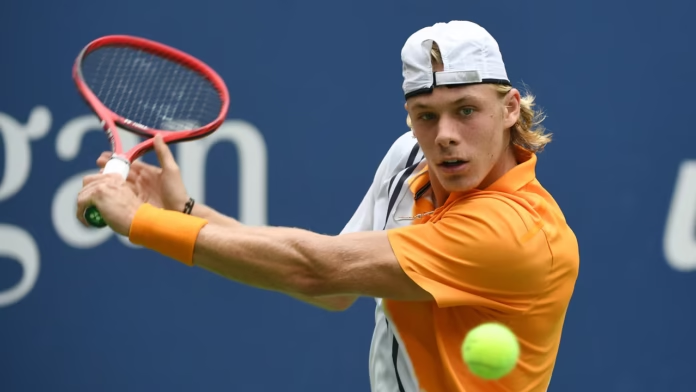
Shapovalov’s game is built on a foundation of bold shot-making, instinctive play, and emotional candour — attributes that delight spectators and baffle analysts in equal measure. His signature one-handed backhand is a thing of architectural beauty: elegant, daring, and occasionally catastrophic. Statistically, his unforced error count tends to shadow his winner tally like a stubborn deficit column.
Nevertheless, recent indicators suggest a potential upswing. Following a measured showing during the North American hard court season and an encouraging stint of injury-free training in London, the Canadian appears poised to regain lost ground. Market watchers — or in this case, tennis pundits — have noted improvements in both physical conditioning and match temperament.
“He’s one of the few players who can hit you off the court on any given day,” said Rupert Langham, senior tennis analyst at RacketMetrics. “But what he’s lacked is the strategic patience to manage the middle rallies. He’s been investing in firepower, but not always in structure.”
A parallel could be drawn between Shapovalov’s style and a volatile growth stock. Investors (or fans) are drawn to the upside: the ability to disrupt, to dazzle, to dethrone. But long-term stability remains elusive. In a field increasingly dominated by clinical consistency — think Alcaraz, Sinner, and the inevitable Djokovic — Shapovalov remains a charismatic outlier.
Off the court, he’s shown maturity beyond his ranking. A vocal advocate for mental health awareness and player welfare, Shapovalov has leveraged his platform with surprising tact. He speaks multiple languages, writes his own music, and manages his affairs with a level of autonomy that belies his age.
With the ATP Tour approaching its final quarter, eyes now turn to the indoor season — a domain where Shapovalov’s aggressive game could thrive. His ranking hovers just outside the top 30, a precarious position, but one not without opportunity. Should he string together consistent performances, an ascent back into the top tier is not beyond reach.
Still, the question remains: is Denis Shapovalov a maturing contender or simply a gifted anomaly? For now, he is both investment and enigma — a talent whose ceiling remains tantalisingly high, even if the margins are razor-thin.